
On this page
What search engine marketing is
You choose the searches you want to show for, write ads, set what you’re willing to pay, and pay each time someone clicks. On Google that is Google Ads; on Bing, Yahoo and DuckDuckGo it is mostly Microsoft Advertising. Ads appear above and below the organic results, labeled as sponsored.
It matters because it is the fastest route to the top of a results page. A new site, a new product or a search your competitors already dominate organically can be reached the day a campaign goes live. And because every click is tracked, paid search tells you quickly which searches and messages turn into customers.
The trade-off is that it stops when you stop paying.
That is why SEM and SEO work best together: ads to win traffic and learn now, SEO to earn the same traffic without a bill later.
How the auction works
This is the part most accounts underuse. Two advertisers bidding the same amount can pay very different prices, because the one with the better-matched ad and the faster, more relevant landing page wins the auction more cheaply.
Improving the page an ad sends people to is often the cheapest way to cut cost per click.
The parts of a campaign
Keywords and match types. You don’t bid on searches, you bid on keywords, and the match type decides how loosely Google matches them to real searches. Broad match reaches far and wanders; exact match is precise and narrow. Negative keywords keep you out of searches you never want to pay for.
Ads. Responsive search ads combine several headlines and descriptions, and Google tests which combinations work. The best ads repeat the searcher’s words and say plainly what happens after the click.
Landing pages. The page must deliver what the ad promised, load quickly on a phone, and make the next step obvious. Sending every ad to your homepage is the most common and expensive mistake we see.
Example for illustration; not a client's data.
Conversion tracking. Without it, a campaign can only be judged on clicks, and clicks are a cost, not a result. Track the action that matters, a purchase, a lead, a call, and let bidding work toward it.
Where your organic data helps
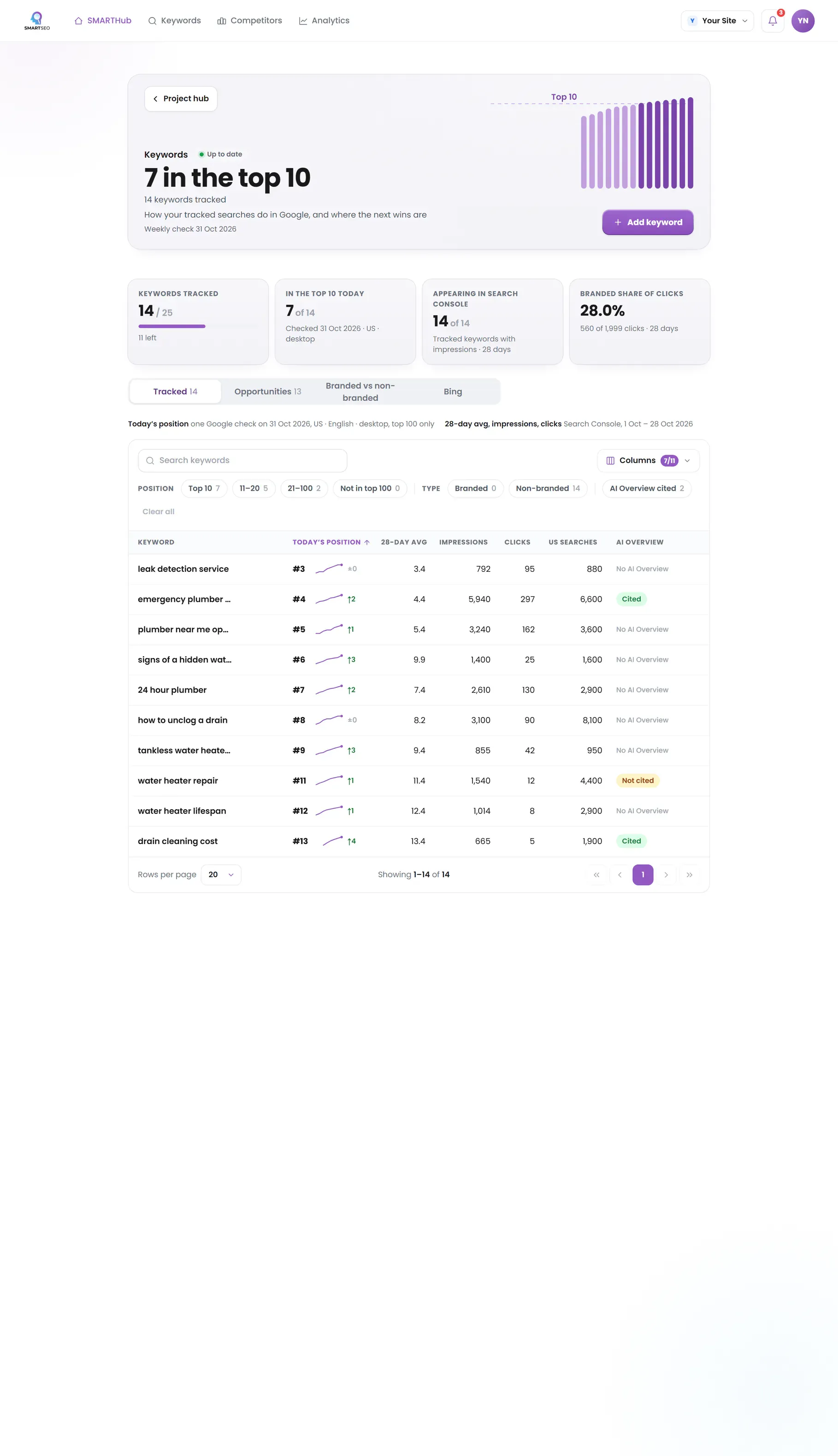
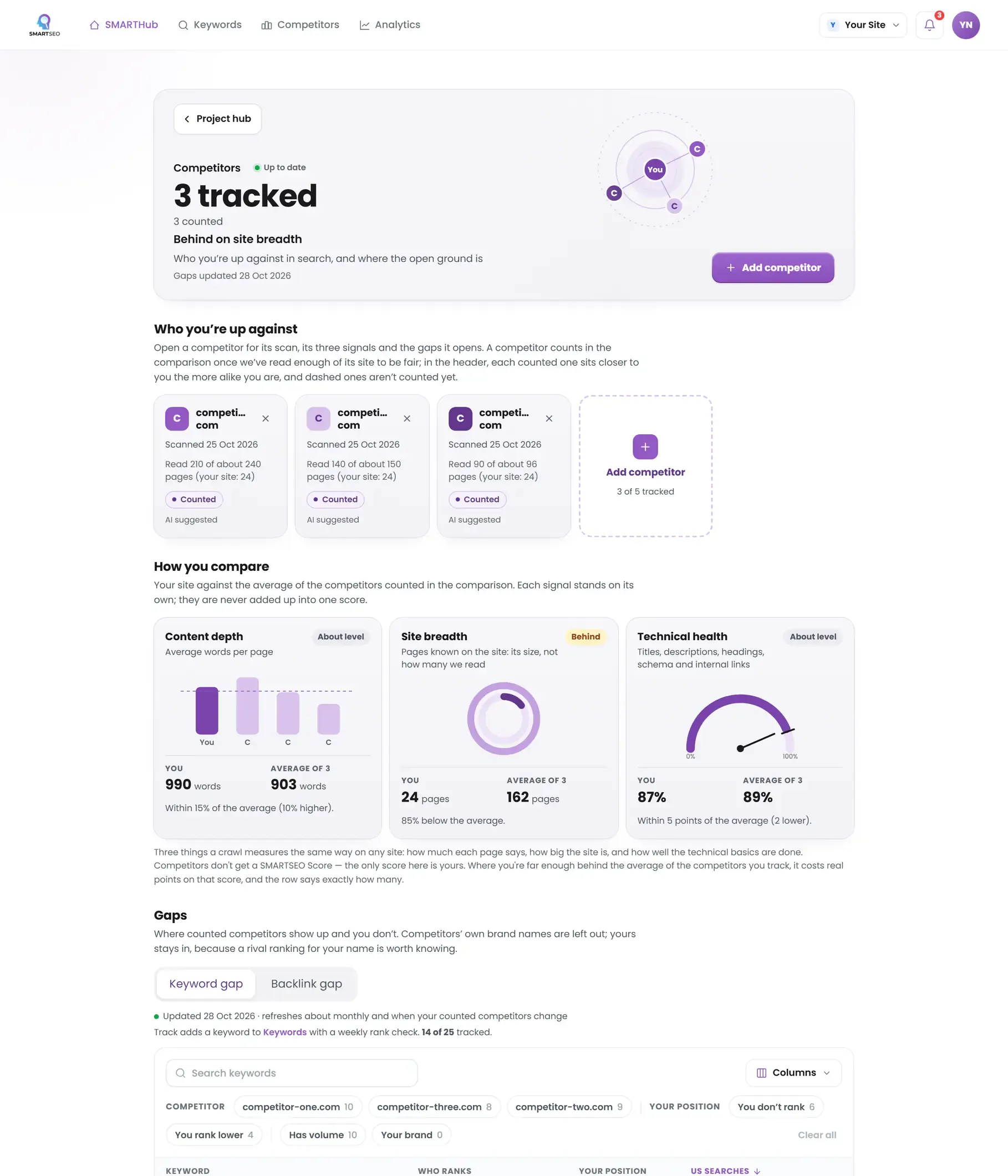
Your organic search data is the best free research for a paid campaign. Searches where you already rank on page one may not need ads at all. Searches where you sit just off page one are good candidates for both: ads now, and an SEO push to take over. Searches your competitors rank for and you don’t show where they’re getting customers you aren’t. Volume tells you how many people search a term at all, and it is a different number from your impressions, which only count the times your site appeared.
How to check it yourself
- Read the search terms report.
If you run ads already, open Google Ads and look at the search terms report: the actual searches that triggered your ads. Add the irrelevant ones as negatives.
- Check your conversion columns.
Then look at your conversion columns. If they are empty, fix tracking before you change anything else; you can't optimize toward what you don't measure.
- Open each landing page on a phone.
Before spending, check your landing pages the way the auction does. Open each on a phone, on mobile data. Does the main content appear quickly? Does the page say what the ad says? Can a visitor act without hunting for the button?
SMARTSEO doesn’t run or read your ad account. What it gives a paid campaign is the organic side: the searches you rank for and how they’ve moved, monthly search volume, the searches your competitors rank for that you don’t, and the speed and mobile checks on the pages your ads will land on.
The problems we find most often
Each of these is a check SMARTSEO runs on every scan, in the words the app uses. Open one to see what triggers it and how to fix it.
NoticePages ranking just off the first page
- What triggers it
- A page’s average position in Search Console is between 8 and 20.
- Why it matters
- On average Google shows these pages around positions 8 to 20, at the bottom of the first page or on the second, where few people look. A little more relevance or a few more links can move them up.
- How to fix it
- Make the page more complete for what people search, and link to it from your related pages with descriptive link text.
WarningPages Google shows often but few people click
- What triggers it
- Google showed a page at least 100 times on page one in 28 days, and fewer than 2 in 100 people clicked.
- Why it matters
- Google already puts these pages on the first page of results, but fewer than 2 in 100 people who see them click. The title and description are what they judge it by.
- How to fix it
- Rewrite the title and meta description so they say plainly what the page offers for the searches it appears for (see them on Keywords).
WarningHomepage is slow on mobile
- What triggers it
- Lighthouse scores your homepage under 50 on mobile.
- Why it matters
- A slow page loses visitors before it loads, and page experience is one of the signals Google uses.
- How to fix it
- See Web Core Vitals for what slows it down.
WarningMain content appears slowly (LCP)
- What triggers it
- The main content of your homepage takes more than 4 seconds to appear on mobile (lab).
- Why it matters
- Largest Contentful Paint is how long the biggest thing on screen takes to show. Over 4 seconds is poor.
- How to fix it
- Speed up the largest image or text block: preload it, compress it, or serve it from a faster server.
WarningMissing mobile viewport tag
- What triggers it
- A page has no mobile viewport meta tag.
- Why it matters
- Most searches happen on phones; without a viewport tag the page renders as a shrunken desktop layout, hurting the mobile Experience.
- How to fix it
- Add <meta name="viewport" content="width=device-width, initial-scale=1"> to the head of every page.
WarningForm that sends data over http://
- What triggers it
- A form sends what people type to an http:// address.
- Why it matters
- A form on this secure page submits to an http:// address, so what people type travels unencrypted and the browser warns them first.
- How to fix it
- Change the form action to an https:// address.
When ads are the only way in
Our own tracked keywords show the case for paid search plainly. None of the non-brand searches we care about reached the organic top 100, and on the latest check Google showed an AI Overview for every one. For a site in that position, ads are the only way to appear for those searches this month, while the SEO work catches up.
SMARTSEO’s own project for its own site, read from stored data on October 28, 2026.
The same data shows where paying would be wasted: on Bing, the few non-brand searches we do appear for already sit on the first page on average, so those clicks come free.
In this section
Questions people ask
Is SEM the same as PPC?
In everyday use, nearly. SEM means marketing in search engines, and in practice that means paid search ads. PPC (pay per click) is the pricing model those ads use. Display and shopping ads are also PPC but not always search.
Should I do SEO or paid search first?
Paid search gives you traffic and data this week; SEO gives you traffic that keeps coming without a bill. Most businesses start ads on the searches that convert and invest in SEO for the same searches, then cut ad spend where organic rankings take over.
How much should I spend on Google Ads?
Enough to get a meaningful number of clicks on your core searches each month, so you can tell what converts. Work back from what a customer is worth to you and how many clicks it takes to win one, rather than from a round number.
Why are my ads expensive when my competitor's aren't?
Google's auction weighs your bid against your ad's expected click-through rate, its relevance and the landing page experience. A better-matched ad and a faster, more relevant landing page can win the same position for less.
Does running ads help my organic rankings?
No. Google keeps the two separate: paying for ads doesn't move your organic position. What ads do give you is data on which searches and messages convert, which is valuable input for SEO.
What we do for you
- Google Ads and Microsoft Advertising campaign setup
- A full account audit with wasted spend named and fixed
- Landing pages built to match your keywords and load fast
- Conversion tracking, so every campaign is judged on results