
On this page
What content marketing is
You publish what the people you want to reach are already looking for, such as explanations, guides, comparisons and answers to common questions, so they find you while they research, and know and trust you when they’re ready to buy.
It matters because content is what search engines and AI tools rank and cite. Without pages that answer the questions in your field, a site has little to be found for beyond its own name. Good content keeps working long after it’s published, unlike an ad that stops when the budget does.
Find the gaps first
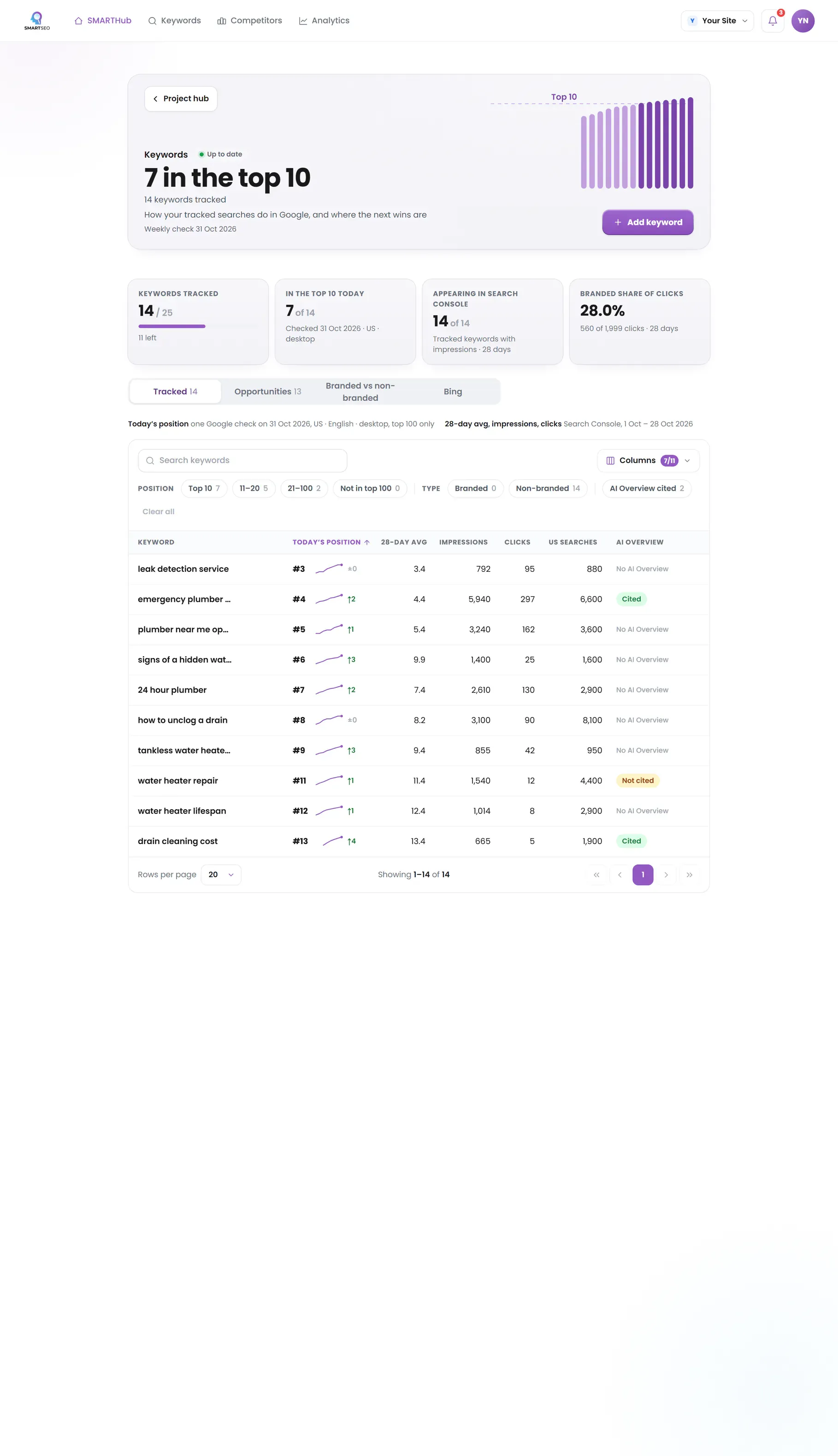
Start with what people search for, not what you’d like to write.
One topic per page is the rule that prevents the most common content problem: two pages competing for the same search.
When that happens, Google often swaps between them or ranks neither well. Plan the topics before writing, and when two existing pages overlap, merge them.
Example for illustration; not a client's data.
Write to answer
A page that ranks answers the question in the first few lines, then goes deeper: the details, the trade-offs, the follow-up questions, an example. Use headings that match what people ask. Use your own experience and specifics, such as numbers you can stand behind, real examples and clear steps, because that’s what generic content lacks and what readers and AI tools look for.
Content for AI answers
Google’s AI Overviews, ChatGPT, Gemini and other assistants now answer many questions directly, citing a few sources. They tend to cite pages that give a clear, direct answer, that are consistent with other trusted sources, and that come from sites others mention. Structured headings, concise answers and accurate facts help. So does being named on other sites in your field.
Keep it current
Content ages. Prices change, tools change, advice goes out of date. Review your important pages on a schedule, update what’s stale, and change the updated date only when you’ve made a real change.
How to check it yourself
- Search your customers' questions.
Search for the questions your customers ask you most. Note who ranks and who the AI Overview cites.
- Find the pages nobody clicks.
Then open Search Console's Performance report, filter to pages, and look for pages with impressions but few clicks, and pages with no impressions at all. Both are content to improve or merge.
SMARTSEO tracks where your keywords rank and whether Google shows an AI Overview for them, finds the searches your competitors rank for that you don’t, checks whether AI answers name you or your competitors, and flags thin pages, leftover placeholder text and pages Google never shows.
The problems we find most often
Each of these is a check SMARTSEO runs on every scan, in the words the app uses. The last ones come from hands-on work, outside what the app checks. Open one to see what triggers it and how to fix it.
WarningLow word count (under 300 words)
- What triggers it
- A live page has fewer than 300 words of text.
- Why it matters
- Thin pages struggle to demonstrate the Expertise the Helpful Content system rewards.
- How to fix it
- Expand to genuinely useful depth (aim for 600+ words on key pages) or consolidate thin pages into one stronger page.
ErrorPlaceholder text left on the page
- What triggers it
- Lorem ipsum or other template filler is still on a live page.
- Why it matters
- The page contains "lorem ipsum" placeholder text, so it looks unfinished to visitors.
- How to fix it
- Replace the placeholder with real copy.
NoticePages Google didn't show in search
- What triggers it
- Search Console recorded no impressions for a page we crawled in 28 days.
- Why it matters
- These pages can be indexed, as far as our crawl can tell, but Search Console recorded no impressions for them in 28 days. Google may not have indexed them, or shows a different address for the same content.
- How to fix it
- Check each one with URL Inspection in Search Console. Improve, merge or remove pages that don't earn a place.
NoticeFAQ or HowTo markup that no longer earns rich results
- What triggers it
- A page uses FAQ or HowTo markup, which no longer earns extra space for most sites.
- Why it matters
- Google now shows FAQ results for very few sites and has stopped showing HowTo results. The markup does no harm, but it won't win extra space in search.
- How to fix it
- Nothing to fix. Just don't add more of it expecting rich results.
CommonTwo pages competing for one search
- What we see
- Two of your pages target the same topic, and Google swaps between them or ranks neither well.
- How to fix it
- Give each page one primary topic. Merge pages that cover the same one, redirecting the weaker address to the stronger.
A new site with no content footprint yet
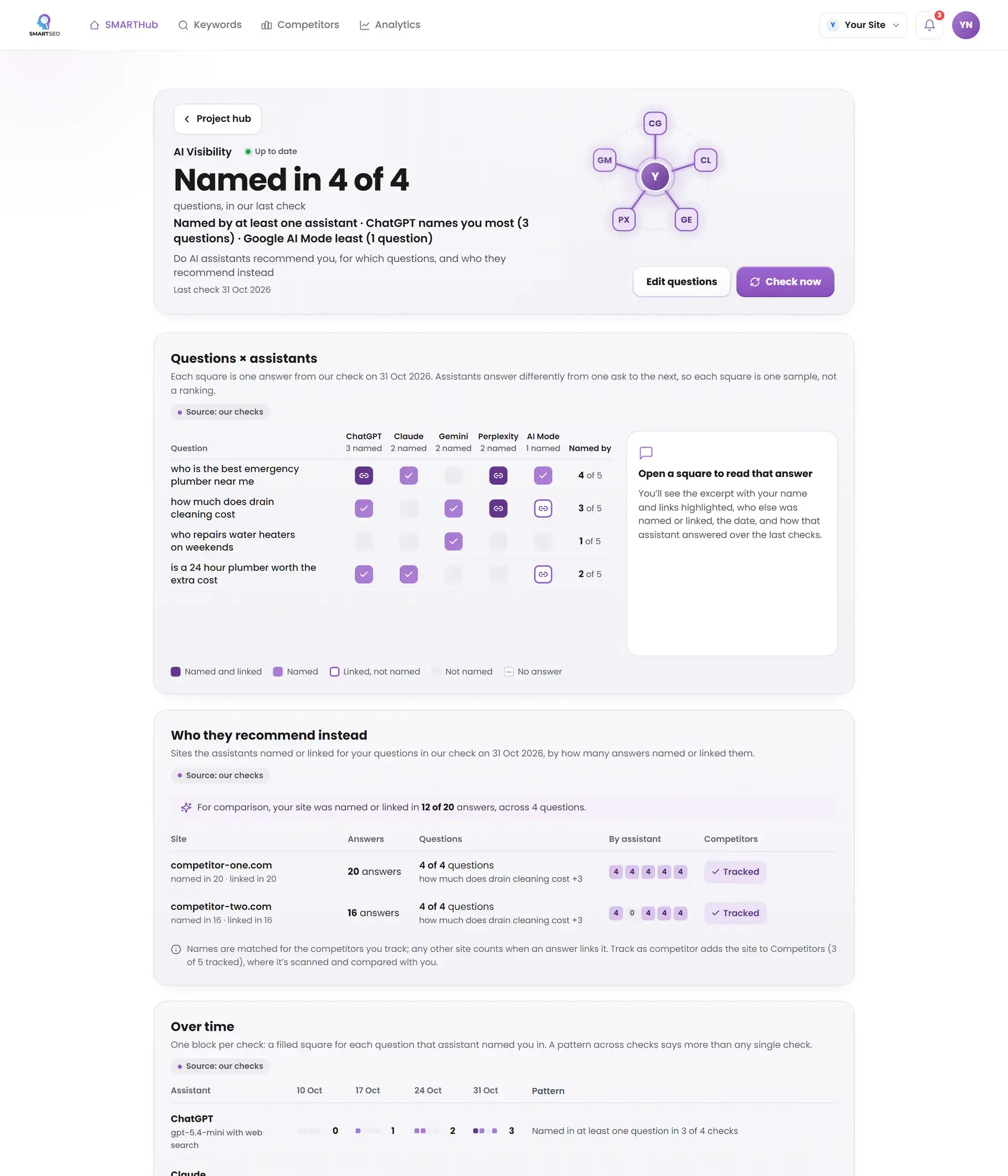
When SMARTSEO first tracked our own keywords, none of our non-brand searches ranked in the top 100. Google showed an AI Overview on every tracked search, and none of them cited us. Across our AI Visibility checks, no answer named us, while the competitors we track were named regularly.
SMARTSEO’s own project for its own site, read from stored data on October 28, 2026.
That's what a thin site looks like from the outside, and it's why these pages exist: each one answers one topic in depth, so there's something worth ranking and citing.
Questions people ask
What is content marketing?
Creating useful content, such as guides, answers, comparisons and tools, that the people you want to reach are already searching for, so they find you before they're ready to buy and trust you when they are.
How long should a page be?
As long as the topic needs and no longer. Thin pages rarely rank, but padding doesn't help either. Cover what someone searching for the topic needs to know, answer the follow-up questions, and stop.
How do I get cited in AI answers?
AI tools cite pages that answer a question clearly and that other sources trust. Write direct answers near the top of the page, back them with specifics, keep facts consistent across your site, and earn mentions from sites in your field.
How often should I publish?
Consistency matters more than frequency. A few thorough pages that each own a topic beat many short posts that compete with each other. Update what you have when the facts change.
Can AI write my content?
It can help with drafts and structure, but content that ranks and gets cited needs what only you have: real experience, specific examples and accurate facts. Google's guidance judges content by its usefulness, not by how it was written.
What we do for you
- A content plan built from the keywords and questions you're missing
- Pages written to rank, one topic each
- Updates to existing pages that have slipped
- Answers structured to be cited in AI Overviews and assistants